Saturday, September 1, 2012
Something's coming...
I'm excited about a new writing opportunity that's about to happen, so if I've misappropriated that excitement by posting this tangentially-related clip of one of my favorite songs from one of my favorite musicals, please forgive me.
Suburban Acrobat started out as a blog for an audience of one, something I created for myself because I knew that if I was going to allow myself to be a writer I had to require myself to write. I never thought when I created it that I'd ever have much of an audience, and indeed so far, I've had little of one.
If you look through the past postings, you'll see stretches of years when I ignored this blog, as well as times when it's shifted from being a place where I could ponder the deeper moral concerns and fragile observations of life. Lately, for example, it's been the only place I could think of to post reviews of the comic books I've been reading a lot of lately; certainly these posts have been of little interest to the person who has visited here to see what I have to say about teaching students or raising children.
Perhaps this new opportunity will allow Suburban Acrobat the chance it's been waiting for to more clearly establish its identity. Because my jonesin' for all things pop culture is about to find a new - and I hope permanent - home. This is thanks in no small part to a collaboration I'm excited to tell you about.
I met Melissa Elliott-Lowell a few years back when we worked together at the high school where I still teach. We weren't particularly good friends at that time but whenever our paths would cross, they'd metaphorically generate these knowing yet exciting sparks. When it came to music, movies, books, television, hell - most anything culturally related - whenever Melissa would open her mouth to express her own opinion, a voice in the back of my head would say: "get out of my brain."
Circumstances are nutty, and the story of what happened next in our fledgling friendship is not meant to be told in this moment and in this posting. But from a distance, it was Melissa's writings and worldviews I most closely found myself aligned with. It was her disappointment in herself for not living up to her promises to herself to be a writer that I most identified with. And it was her turns of phrase that I found myself laughing the hardest over.
So I pulled the trigger and asked Melissa to start a site with me. And she agreed. And I can't wait to share that site with you, a place where two Midwestern, suburban parents who love to soak up popular culture and love language will write, reflect, and hopefully most importantly, entertain readers like yourselves. This place is currently being developed. Names are being bandied about. Site features are being discussed. Options for the site's location on the web are being explored.
But I couldn't wait until we were ready to introduce you to Melissa's work. No writer has as many witty asides in their writing this side of Seth MacFarlane's "Family Guy" scripts. And no one but me is as shameless about holding up a lighter at a Barry Manilow concert on one night and being totally hipster the next. So before we unveil our first posts together, click on this link and go to Melissa's blog, entitled Uncomfortably Numb.
And trust me. Something's coming. Something good...if I can wait.

Saturday, August 18, 2012
So far, it's Wonderful - DC's New 52 Review #10: "Wonder Woman"
 She's the most famous female comic book hero of all-time, but she's never been given the high-quality treatment needed to carry her own book title, and so Wonder Woman has been best portrayed in comics as a member of the Justice League. So of all of DC's new line of comic reboots, it would seem like our favorite heroine from the Amazon was the classic character most in need of a fresh and compelling start.
Don't look now, but I think they've figured it out. With an engaging story by Brian Azzarello and some of the most unique art in the DC Universe courtesy of Cliff Chiang, "Wonder Woman" is as meaty of a title as any in the New 52.
Somewhere in Virginia, a young woman named Zola is being hunted. She doesn't know this yet until a strange, bluish alien man shows up to tell her that she's in danger. Two centaurs appear and send a spear right through the man's stomach, but he manages to throw Zola a key that teleports her to the London bedroom of Diana. Yes, Wonder Woman. When the two hold the key together, they return back to Zola's farm, where Diana discovers that the seriously-wounded man is Hermes. He wants Diana to protect Zola and tells them both that she is pregnant with Zeus' child.
On Mount Olympus, Hera is fully aware of the fact that Zeus has sent Hermes to protect the woman carrying his latest child. Diana learns this after taking Zola and the injured Hermes to Paradise Island, where she meets up with her mother, Queen Hippolyta, who shares the news. Meanwhile, Hermes tells Zola the story of how Hippolyta could not conceive a child and fashioned one out of clay on a moonless night, praying to the gods for a miracle and waking to find a live baby, Diana, the "perfect Amazon" because "no male seed created her."
Strife, one of Zeus' daughters, arrives at Paradise Island and taunts the Amazons. She tells Diana that they are sisters and that Zeus is, in fact, her father. Hippolyta regretfully confirms the news that Diana was not made from clay and swears that the story was designed to protect her from Hera's wrath, but Diana is inconsolable; her life has been a lie. Diana tells the Amazons that "Diana" is dead and she is now "Wonder Woman."
Hera arrives to seek revenge against Hippolyta but ultimately spares her when Hippolyta begs for her forgiveness. Or at least that's what the reader thinks until Diana returns to Paradise Island to discover that the embrace between Hera and Hippolyta was not one of forgiveness, but instead, one of condemnation; Hippolyta has been turned to stone.
Guest artist Tony Akins takes over for Chiang for issues #5 and #6, and the art, while still crisp, is noticeably more traditional and, therefore, not as striking as in the previous issues. Issue #5 introduces a mysterious man who calls himself Lennox and knows a lot about Wonder Woman, as well as Poseidon, with whom Wonder Woman spars. While Wonder Woman deals with Poseidon, Lennox is talking to Hades. After another confrontation with Hera, Hades snatches Zola and tells Wonder Woman that if she does not keep up her end of the bargain, Zeus' bloodline will end with her.
Wonder Woman and Hermes find Eros in Italy. Eros takes them to Hephaestus, where Wonder Woman gets the next big shock of her life as she is introduced to all of the male children of Amazons, rescued by Hephaestus in exchange for weapons he's created. Wonder Woman attempts to rally the men, her brothers, to help her in her fight, and is distraught when she learns that they want no part of it, or her.
Hephaestus gives Wonder Woman access to his arsenal of armor and weapons to prepare her for her march into Hell. Hermes delivers her there, along with Eros' golden guns. Wonder Woman finds Zola but Hades refuses to release her unless she delivers Hera to him to be his wife. But then, Hades notices that Wonder Woman is carrying the pistols of Eros and decides that he will release Zola for those instead. Wonder Woman agrees, and is promptly shot, her bullet-proof bracelets unable to stop a bullet from Eros' gun. Hades announces that he will marry Diana instead. He insists that Diana be bound by her truth lasso during the ceremony to guarantee that she tells the truth as to whether or not she loves him. But Diana escapes and, before leaving hell, shoots Hades with a bullet from Eros' gun.
That's how the first 10 issues end, but I've also purchased the next two, so I'll push the story a little further forward. Issue #11 returns to the team of Azzarello and Chiang alone, and I have to say that I prefer "Wonder Woman" when the two of them are in control. Sun and Moon, Apollo and Artemis, arrive as Wonder Woman and Hermes take Zola to a doctor's appointment. They take Zola and deliver her to Hera, where Apollo expects Zeus' throne in exchange. Hera acquiesces, but Wonder Woman and Hermes have already arrived to stop them.
As a fight commences in issue #12, Zola's water breaks. And when the baby is born, Hermes steals it and gives it to Demeter. Wonder Woman sets out to find the baby and return it to Zola, propelling this already exciting story further forward into future issues. The story will continue from here after September's origin issue #0.
I have loved Greek mythology ever since I was a kid, and so I've found myself really enjoying "Wonder Woman," a title I admit that I initially began purchasing mostly out of a sense of duty to check out one of the biggest names in the DC Universe at the start of this reboot. I don't recall ever having purchased any Wonder Woman comics before, except for a few special titles here and there, so I don't have much to compare it to, but I'm hearing that this is (so far) one of the stronger tellings of a Wonder Woman story. I would agree that it feels substantial and has kept my interest. I originally wanted to collect the first 10 issues of "Wonder Woman." Now, I actually want to keep reading to see what happens next!
Chiang's art alone makes "Wonder Woman" a title worth looking into. So as the entertainment gods continue to debate whether or not there will ever be a Wonder Woman television show or film franchise, here's some quality Wonder Woman storytelling to tie us over, and maybe even inspire what we'll hopefully one day see on the big screen.
Saturday, August 11, 2012
He dies and comes back to life over and over...except for this one time... DC's New 52 Review #9: "Resurrection Man"
 Mitch Shelley is an interesting guy. He can sense metal wherever he goes: metal plates in the joints of war veterans, tongue piercings. And he remembers the metal of the surgical tools used to attempt to save his life when he died. "Everything tastes of metal," he says.
But the next thing we know, Mitch isn't dead. He's "borrowing" an ATM card and boarding a plane. While on the plane, he meets an attractive woman who, on a dime, transforms into a winged creature who proclaims that Mitch's "soul is overdue." The ensuing chaos ends in a plane crash, killing everyone, including Mitch...
...who "un-dies" a half hour later. And so begins "Resurrection Man," one of the new titles in the DC Comics New 52 reboot.
I had never heard of Resurrection Man before and so did a little online research about him. The character, it turns out, previously existed but is nonetheless rather new to the DC Universe. He was created in 1997 by Dan Abnett, Andy Lanning and Jackson Guice and had a two-year run in print. Abnett and Lanning remain in charge of this, um, newly-resurrected version of the comic, this time along with Fernando Dagnino.
By virtue of his hesitant participation in a botched science experiment (perhaps the reason why his last name is Shelley, a nod to "Frankenstein"), Mitch experiences an odd sort of immortality; he loses much of his memory of what happened prior to each death, and is resurrected from the dead within minutes of dying. He feels all of the pain experienced with each death and is not immune to it. Even more interesting, each resurrection brings with it a new superpower unique to and informed by the situation that last killed him.
In this reboot, Mitch is being tracked down by a group of individuals who appear to share the mark of a red tear in the corner of each one's right eye. Unaware of his being pursued, Mitch visits the nursing home where his dad lived to find that he's died. Suffering from memory loss, Mitch asks the residents for details about his father. Two women who appear to have a history with Mitch show up to "retrieve" him, guns blazing. They "kill" Mitch and upon revival, he is able to take the form of water and put up a fight. He is killed again regardless and momentarily held captive in a sort of purgatory. Once he returns, he is killed by the women again but then they are confronted by someone calling himself "The Transhuman," the same name that a man in the nursing home had earlier told Mitch was his super-villain name prior to his time there, a piece of information that Mitch would be unable to remember.
The women, identified in issue #4 as Carmen and Bonnie, engage in a gunfight with the Transhuman, but they are all overpowered by the return of the winged woman from the plane, Suriel, who claims to be a "special angel from Heaven" sent to nab Mitch. A confrontation follows that leaves Mitch so bloodied that Suriel is not even sure that he will be able to resurrect again, at least not on Earth. Of course he does, and the fact that he is alive despite the condition of his body, coupled with his confusion over who and where he is, leads medical personnel to admit him to Arkham Asylum, where he begs the guards and workers to kill him so that he can prove that the stories they find to be delusional are, in fact, true. They name him "Deathwish."
Mitch escapes from Arkham and heads for Metropolis, allowing this title to cross over with two of the most famous cities in the DC Universe. While being tracked down in Metropolis, in issue #7, a man named Mr. Untouchable (who is able to surround himself with a red glowing force field) causes the building to set on fire thanks to the presence of a meth lab in it that was being uncovered at that moment by the authorities. In probably the coolest moment for Resurrection Man up to that point, he starts to push aside his confusion and embrace his urges to save innocent people from the building and fight crime, doing most of this as a flame of blue fire. In this segment, he looks awesome.
In issue #8, Mitch is at the Metropolis Library researching clues about his past when he literally runs into a woman named Kim Rebecki who's been hired to track him down. Kim has psychic powers and knows that there's something unique about Mitch. But before they can get into it, a man called The Butcher - who hired her - arrives. "He steals lives to power his magic," Mitch is told. Naturally, he wants Mitch so that he can be eternally and powerfully refueled. After ridding of The Butcher, Kim tells Mitch that he was once the director of a military applications developer called The Lab. But once again, Mitch fails to gain more information before the two are interrupted, this time by the Suicide Squad.
The Suicide Squad plans to disassemble Mitch's again-dead body and transport the pieces separately in the hopes that it will prevent him from reviving, but Carmen and Bonnie show up to stop them. But Mitch resurrects as "living metal" and escapes. Before he finally gets away, though, his hand is cut off and sent to a lab to be studied. Nonetheless, a new hand grows in its place and Mitch can tell that there's something different about it.
In issue #10, Kim and Mitch make discoveries that could link the Transhuman's lab to Mitch's past. But dueling forces led by Suriel and the sarcastically sinister Outcast arrive to claim him, a virtual duel of heaven and hell on Earth for Mitch and his soul. Mitch makes a deal to buy him some time; he'd like one week to find out the truth about who he is and says he will then surrender to one of them. This sets up a nice cliff-hanger for the end of the first ten issues. But since I've also purchased issues #11 and #12, I'll include them in this review.
The artwork in "Resurrection Man" begins to get more clear (and, more awesome) around issue #9, as Jesus Saiz takes over for Dagnino, and gets even better when Javier Pina joins Saiz with issue #11. Having noticed that Saiz only draws three issues and then, with #12, Pina takes over, I was a little worried about the consistency of the book. Indeed there is a difference, but I would say that they are improvements.
Issue #12 opens with Resurrection Man flying over Gotham City. He doesn't know how he got back there or how he's able to fly. He only assumes bits and pieces about the lab that might hold the secrets of his past and how he came to be the way he is. But before he gets too far, Batman apprehends him as an escapee from Arkham, and Mitch is soon in the custody of the entire Justice League. This unexpected and thrilling crossover with the main characters from the DC Universe reach an even higher climax with the arrival of Darkseid. But even better than all of that is the end of this issue, which finds Mitch being picked up by a giant robot being operated by a man inside, who reveals himself to be...Mitchell Shelley? Huh? The last page says "Next: Issue #0...where everything is revealed!"
I have really been enjoying "Resurrection Man." I think it's one of the most interesting and engaging titles in the New 52, and it's been fun to follow a new character in a sturdy new title with a great storyline and a mysterious past to reveal. Unfortunately, only as I was researching a bit to write this review of the title did I learn that "Resurrection Man" is among four titles to be cancelled in the second wave of New 52 cancellations. I was lucky the first go-round, and I had not been reading any of the titles cancelled. This time, however, I'm reading half of them, this book and "Justice League International." This is the one that I'm really sad to see go! To say that I'm disappointed is an understatement.
So next month's issue is set to be a #0 origin story issue, which if nothing else might clarify the character of Mitch Shelley in the DC Universe and pave the way for him to show up in other titles sporadically. Still, it's a shame that readers didn't latch on to his own book, a standout favorite for me in the new 52. Here's hoping that at some point, Mitch will be capable of yet one more resurrection.
Friday, August 10, 2012
Not super enough - DC's New 52 Review #8: "Superman"

Now you can argue that his origins as an intergallactic orphan lend some grit to the Superman saga, and as I've grown older, I've come to appreciate that this is in fact the case, but only up to a point. And when it comes to Superman titles in the New 52, "Action Comics" directly plays on the emotions of how Kal-El came to Earth, whereas "Superman" really does not. And since this is one of the most interesting aspects of Superman, it is also the case that the "Superman" title has not - at least so far - kept my interest as well as the more nuanced "Action Comics" has.
For the first four issues, writer George Perez and artist Jesus Merino take Superman down a bizarre path, and in a manner that I found difficult to engage with. Wearing an updated costume that amounts to mostly minor tweaks when compared to "Action Comics"' more radical denim-and-work-boots makeover, a super-mysterious and slightly distant and unfriendly Superman presides over Metropolis, defending the city first from some sort of invisible enemy, then from a fire element being and finally from an ice element being that appears to have originally taken the form of (or has possessed) one of Clark Kent's co-workers. None of these beings speak an Earth language, but they appear to speak the same language, and it might be the language of Superman's home planet.
The Daily Planet building has been demolished but replaced with a new, Trump-ed up version, and a man named Morgan Edge now controls the company, putting Lois Lane in charge of its television division and thus adding a modern twist to the famous details of the Superman story we learned as kids.
Superman is blamed for the destruction caused to Metropolis while fighting these enemies, and with each passing issue, his behavior seems less and less like the behavior of Superman that we're used to. People really start to panic after Superman appears to absorb the elements of his enemies and then begins speaking in the same alien language (Krypton?) as them. Before the end of issue #5, Superman is holding a man upside down from atop the Daily Planet and threatening to drop him. And before readers can get angry about this new, abrasive Superman, the issue concludes with what appears to be the real Superman, floating somewhere in space, somehow trapped, finding himself covered in some sort of black, dotted substance.
Meanwhile, Supergirl shows up in Metropolis and rescues the man that "Superman" almost kills. All of issue #6 is essentially a battle between Superman and Supergirl, with Lois and her camera crew led by a Jimmy Olsen who's drawn too look much to young following the brawl to capture footage. Somehow, the real Superman arrives to dispose of his impostor and repair things with Supergirl.
Had I not read further, I think I would have been done with "Superman" by the midway point of its run so far, but as was the case with many of the New 52 titles, a new team picked up with issue #7 with this title as well, generating some noticeable improvements. In fact, issue #7 on feels terribly disjointed from the first half; its story and approach are both very different. Jesus Merino remains on the title, but the book is now being written by Dan Jurgens and Keith Giffen.
At the start of #7, an alien being arrives to level Superman, who still has not fully regained the trust of the people of Metropolis. This being turns out to be a soldier for Helspont, a scorned creature with a skull head lit in blue flames seeking Superman to serve him in seeking revenge on those who once imprisoned him. Helspont wants Superman - and any other "metahumans" he cares to enlist - to help him in his quest and, in return, offers Superman control over Earth. Superman, of course, refuses the deal.
Another startling change reveals itself in #7, when we find out that when Clark Kent changes into Superman, the "S" logo on his chest, worn on a t-shirt under his work clothes, now absorbs all of his street clothes and transforms Clark head-to-toe in his Superman gear. This is achieved, we learn in thought bubbles, through something called "Kryptonian biotech."
Helspont is actually a pretty cool villain, as is Anguish, a female character introduced in #9. Superman confronts her when she robs a bank simply to take an old locket and necklace from a safety deposit box. While attempting to engage Anguish in combat, Superman learns that she cannot feel anything, making her difficult to fight. Her back story, it turns out, is that she was severely abused and neglected as a child, leading to her powers of not being able to feel anything. I thought this was a cool origin story for a character. Issues #9 and #10 were probably the best of the first 11.
There are more things I don't like about this "Superman" than things that I do. The artwork looks great, and I really enjoyed it. But in terms of the writing, so much of the narrative is being told in Superman's thoughts as opposed to through actual dialogue or, even better, simple action and the illustration of it. This Superman is too chatty with the interior monologue, boxes and boxes of it. And since the opening half dozen issues present us with a Superman who might not have actually been the real Superman, it's been hard to connect with the character. Add in the fact that the title is nearing the dozen mark in issues and hasn't really dealt much with the historical elements of the Superman mythos, save for a few cryptic connections to Krypton that haven't panned out yet.
One final trait of "Superman" that I find irksome is that the writing team connects this title to so many others, from "Superboy" to "Action Comics" to "Supergirl." If I was reading all of those titles, that would probably be a good thing, and I guess it's cool that the writers work hard to make these connections and link up this family of characters in the DC Universe. (See my review of "Action Comics" for more on where that Superman fits in with this one in the grand scheme of things.) But I am not reading all of those titles and don't plan to, and thus find myself irritated with the frequent use of footnotes and reminders to issues and titles I haven't read. In this way, "Action Comics" feels more self-sustaining, and thus is easier to read.
I feel a bit guilty that I haven't really latched on to a Superman title, but if I had to pick one, "Action Comics" might edge out "Superman," though slightly. I think my verdict on both, however, is to discontinue monthly purchases of individual issues and wait to see if a story arc evolves in either title that is robust enough to spark my interest, in which case I could get caught up again through the purchase of trades. Until then, I suspect my monthly dose of Superman will come in the form of "Justice League."
Tuesday, July 17, 2012
Superman is black? Clark Kent is dead? DC's New 52 Review #7: "Action Comics"
 The first surprise when reading the new "Action Comics" is the image of Superman on the cover wearing blue jeans and work boots. You'll exclaim "that's not Superman!" and then you'll have to file that thought away so you can get on with it and start reading.
"You know the deal, Metropolis - treat people right or expect a visit from me," our denim-clad Supes exclaims to a group of onlookers after he's just finished holding a corrupt business man above his head on the ledge of a balcony and then plummeting with him down the side of the building before safely dumping him on the ground as the man dumps his confession. This feels more like vigilante Superman, more Batman-ish. His tactics are a little rougher and his criminals more like the everyday white collar assholes running Wall Street right now than otherworldly bad guys in cool suits.
Like Batman, Superman's first appearance in issue #1 is hard for onlookers to interpret, and they try to arrest him when he takes off running. But one thing that hasn't changed is that Lex Luthor is looking for him. And soon after we get this information, we get the next "what the hell?" moment in the reboot when we learn that Jimmy Olsen and Lois Lane do not work with Clark Kent, but at a rival newspaper. Say wha...?
Luthor captures Superman after he prevents a train accident from getting worse, and issue #2 begins with Superman strapped in an electric chair. As part of the reboot, this "Doctor Luthor" seems to be just discovering, as he's running electricity through the Man of Steel, that he is not human. Over the course of the next few issues, expert DC author Grant Morrison begins to build the Superman mythology and origin story back up, rebooted but familiar. To add interest, this occurs in a non-linear fashion, beginning with Luthor's people, who find themselves unable to shoot bullet holes through Superman's indestructible cape.
Lois Lane's father, it turns out, is General Sam Lane, who is working on the Superman case and must fend off his daughter's attempts to call in a nepotistic favor for the benefit of her newspaper reporting. While her father tries to fend her off, Superman breaks free and ends up discovering the small vehicle that transported him to Earth as a baby. He begins to have an other-worldly connection to his past and history while gazing upon the small ship, hearing names from his past.
For something different, Morrison and his crew end issues 2 and 3 with interviews with Morrison and artist Rags Morales about many of the details that have gone into both the "Action Comics" reboot as well as the other characters and titles in the Superman universe. Everything from Superman's new attitude to his revised clothing choices is covered in detail, and this is a must-read for fans of the character.
By issue #3, Superman is facing a hostile Metropolis, and I was reminded of how film director Christopher Nolan ended "The Dark Knight" with people being misled to believe that Batman was the villain. Much of this is thanks to the public relations work of Glen Glenmorgan, the aforementioned business man who was once hanging by an ankle from a building at the hands of Superman and is now riling up the public against him. Police search the apartment of a vaguely Harry Potter-ish Clark Kent, but it is his landlady who makes a discovery when she pulls out Clark's Superman uniform after they leave. In addition, this issue gives up the back story as to what gave Superman's parents cause to send him away, and delivers the creation of potential foe Steel when a lab experiment backfires.
John Henry, the man trapped inside the robot soldier's armor, is clearly possessed by some other force as he takes on Superman in issue #4, and an origin story for the character ends the issue. Morrison and Morales appear to be ending each issue with shorts to supplement the ongoing story, and one of the best things about "Action Comics" is that the issues actually feel meaty, almost justifying the $3.99 price tags, which is the elevated-by-a-dollar marquis amount charged for only the flagship titles.
Issue #5 takes a step back and gives us the detailed origin story of how Kal-El came to Earth and was found by Jonathan and Martha Kent. The issue's touching back story short, "Baby Steps," chronicles the Kents' struggle to conceive a child of their own and makes more rich the bond between them and their eventual adopted son. Meanwhile, in the present, as Superman looks upon the ship that brought him here and relives his history, a few other super-humans arrive. Most interesting among them is a Superman from five years in the future.
The plot of "Action Comics" really begins to thicken at issue #6, and to the point where multiple readings might be required to gain understanding. It's so complex, in fact, that I hesitate to recap some of it for fear of getting it wrong, but one moment that sticks out is when one of future-Superman's traveling companions accesses his memory and we see a young Superman tackling bulls under Jonathan Kent's watchful eye. This is a lovely moment of back story establishing the home-spun, fatherly wisdom of Kent, leading up to us witnessing Superman's first moment of flight. The issue-closing "Last Day" shows Clark Kent unloading his adopted parents' farm after they've both passed away.
Issue #7 connects Superman to the memories of his past as the name of his home planet Krypton is spoken and sinks in for him as more than just a vague recollection. He finds out that he's hearing these things from the "Collector of Worlds," who knows "everything there is to know." The Collection reveals the various forms its identity takes on various planets; on Earth, for instance, the Collection is amusingly revealed as the Internet. But the Collection also poses Superman with a terrible challenge; he can save either his home planet or Earth. This is meant as a test to see where his allegiances lie, but Superman is set on not making a choice. Nor will he join the Collection, which already has Steel in its sway.
In issue #8, Superman rescues Steel from the Collection, and Superman appears to be back in Metropolis' good graces. And then, Superman becomes a black man.
Say what?
Yes. Issue #9 introduces us to "Superman of Earth 23," United States President Calvin Ellis. No subtlety was attempted in drawing comparisons to Barack Obama. The issue is interesting and slightly confusing and includes everything from the apparent death of Jimmy Olsen to the hint at a "multiverse" from which this new black Superman originated, reinforced when he calls in the Justice League and all of them are alternate versions of the characters we know as well. The issue wraps on an amusing note as black President Superman places a call to the leader of a country called Quarac to play hardball over their nuclear program and we see that the president is making the call from a bluetooth headset while on duty as Superman. I'd be lying if I said I understood what was going on here, but unlike the confusion aroused in me while reading "The Savage Hawkman," these are curiosities that I'm actually interested in finding answers to.
The story gets more normal when, at the start of issue #10, a man named Maxim Zarov, who goes by "Nimrod," is milking information about Clark Kent from the farmer to whom Clark left his parents' house and land. Nimrod clearly knows Clark's alias and plans to murder him. But before Nimrod can get to Clark, it appears that Clark is blown up by a suicide bomber outside of the Daily Star where he works. That's what Clark's landlady tells Zarov, too...that is until Superman appears to take care of Zarov, which confuses her further, especially when Superman tells her that Clark is, in fact, dead, and that he'll return to explain things to her later. We're left with the impression that Superman has decided that his Clark Kent identity was no longer safe and had to be destroyed, a nice cliffhanger.
Because another month has gone by since I've collected my first 10 issues of "Action Comics," I've already had the chance to buy and read #11, so I'm including a little bonus summary here. The issue begins with the introduction of a new enemy called Metalek and ends with the apparent mental takeover of some key individuals in Metropolis. In between, we witness Superman discuss the death of Clark with Batman, a really interesting and satisfying exchange.
Like I said before, there's something satisfying about how dense "Action Comics" is with plot, mythos and detail. It certainly keeps me interested. At the moment, I see no reason to stop reading the title, other than the fact that Superman has never ranked at the top of my list of favorite characters in the DC Universe. I am also curious to see how this title compares to "Superman," a book I've also collected this past year but have not yet read. Once I do and post a summary and review for that book, I think I'll have a clearer sense as to whether or not I'll continue on with this title, that one, or both. In any case, I am sure that writer Grant Morrison continues to be one of the most significant DC names holding a pen. And given that Superman's back story is perhaps the most famous one of all, it's been really interesting to see how Morrison and his crew give that famous history a fresh coat of paint. In addition, the "death of Clark Kent" is a bold early move to keep us reading. That said, the black, parallel-universe Superman is confusing and unclear.
For now, I'm still reading.
Sunday, July 8, 2012
A flying gladiator weighed down by his origins - DC's New 52 Review #6: "The Savage Hawkman"
 I don't think I ever knew a thing about Hawkman's origin story, and I know I never bought any Hawkman books as a kid. But he still made an impression on me. As a team member of the Super Friends in the 1980s, I remember most that my Hawkman action figure was the biggest one. He was taller than Superman. More ripped than any of them. And with those huge wings that flapped when I squeezed his legs together? Kick ass.
Reading "The Savage Hawkman," one of the New 52 titles in the DC Universe, was therefore something I was really looking forward to. But I got lost quickly, and frustrated in my confusion.
We begin the story of Hawkman with a man who will do anything to deny his past and start clean. Through narration, Carter Hall tells us that he was once known as Hawkman but "that's ancient history...that ends right here, right now." Pulling his pickup truck to the side of the road in a remote location, Hall starts a fire and throws each piece of Hawkman's uniform into the fire. But the costume, made from a property called "Nth metal," reacts in the fire, causing an explosion. Hall is engulfed in flames but wakes up somewhere else to find that he's not only alive, but healing.
It appears that Hall wakes up at a lab where he works. He puts on a hazmat suit and joins other scientists in viewing some sort of alien life form. One explodes from its trappings and begins killing, and Hall, while trying to fight one off, feels his body changing. The Nth metal, it seems, has morphed with his muscles and he transforms mid-battle into Hawkman (in a way that sort of reminds me of how Bruce Banner becomes the Incredible Hulk). His foe, we learn, is Morphicius, an alien that feeds off of energy and, upon grabbing Hawkman, is delighted by the unique and power Hawkman is giving off. But the Nth metal is too powerful for Morphicius, burning him but also empowering him.
The scene moves to Manhattan and the Non-Lethal Alternative Studies headquarters, where Hall is recuperating. Here, he wonders if since he can't escape the Nth metal, he can learn to control it. When he returns to the place where Morphicius first escaped captivity, the Nth metal triggers Hawkman and a hologram appears to warn him of Morphicius's power. Inside the lab, Dr. Hoarth Kane and an assistant named Askana appear to be helping Morphicius. Instead, they are dissecting him, and yet he survives the dissection. Once again, Morphicius engages Hawkman in battle and refers to Hawkman's powers as being "Thangarian." (This perked me up, as I remembered that Thanagar to be the planet where Green Lantern Isamot Kol is from.) Hawkman defeats Morphicius but Dr. Kane escapes. Issue #4 ends with Carter Hall walking down the street and realizing that people passing him appear to be corpses. He wonders if the Nth metal is toxic and poisoning him as mercury would.
Professor Ziegler calls Hall to his lab. He hands Hall an ancient text, and when he touches it, the symbols come to life for Hall. As Hawkman, Hall confronts a man named Digby who gave Ziegler the book. Suddenly, a between-worlds apparition appears, known as the Gentleman Ghost. Hawkman is able to connect the Gentleman Ghost to what he saw in the book. Gentleman Ghost tells Hawkman that he invited him to see him so that he could request that Hawkman find something called the "mortis orb."
While searching for the orb, Hawkman meets a woman who claims that her husband was buried with it. Learning that the mortis orb can raise the dead, Hawkman puts two and two together and digs up the grave of Julius Gates, where he finds it. After grabbing the orb, Hawkman experiences a surge in power and the dead begin to rise. The Gentleman Ghost tells Hawkman that the orb needed to contact with the Nth metal to break a spell and allow the dead to rise. He takes the orb.
While searching for "Gentleman" Jim Craddock, Hawkeye encounters Static, a new hero in the DC Universe who, if I'm not mistaken, already crashed and burned as a title/series. A punky kid with the ability to channel electricity, Static helps Hawkman deal with the undead. They soon catch up with Gentleman Ghost and defeat him for the orb, which Hawkman flies to Anarctica to hide. As issue #7 ends, he is home in Manhattan, where Askana arrives. An alien shape-shifter, she shows up to fight Hawkman but then reveals that she actually wants his help.
Do you want me to stop? Because I really want to stop.
Suffice it to say that I have found Hawkman to be too complicated to get into. The Nth metal, the undead, the alien origin planet, the book, the orb...It's just so confusing! Some improvement comes in issue #9 when the somewhat watercolor-y and non-traditional artwork of artist Philip Tan is replaced as a part of a new team overhaul for "The Savage Hawkman." This made me think of "Green Arrow," another title that didn't seem to be gaining traction, leading to a new creative team (though in that case, the new team made it worse for me, not better).
Come issue #9, the drawings of Joe Bennett truly kick "The Savage Hawkman" into gear, and he is now looking like the bad ass Hawkman I always remembered. But sadly, the origin mythos is so dense and complicated that even the new creative team could not pull me back in. The villains in issue #10 range from people dressed like "Tron" to a juiced-up, armored ninja, and Hawkman himself appears to have elements of an ancient Rome gladiator thrown into the mix with his futuristic metal suit. Whatever the case, it all just gets to be too confusing for me.
I really wanted to like "The Savage Hawkman," but I'd also like to stop spending so much money every month at the comic book store. I think I might be interested in picking up the #0 origin issue that comes out in September, but unless that really changes my mind, I think I'm done with Hawkman, though I hope the dude shows up in some JLA stuff, because there's something about him that I still think is pretty cool.
To the depths of Dick Grayson - DC's New 52 Review #5: "Nightwing"
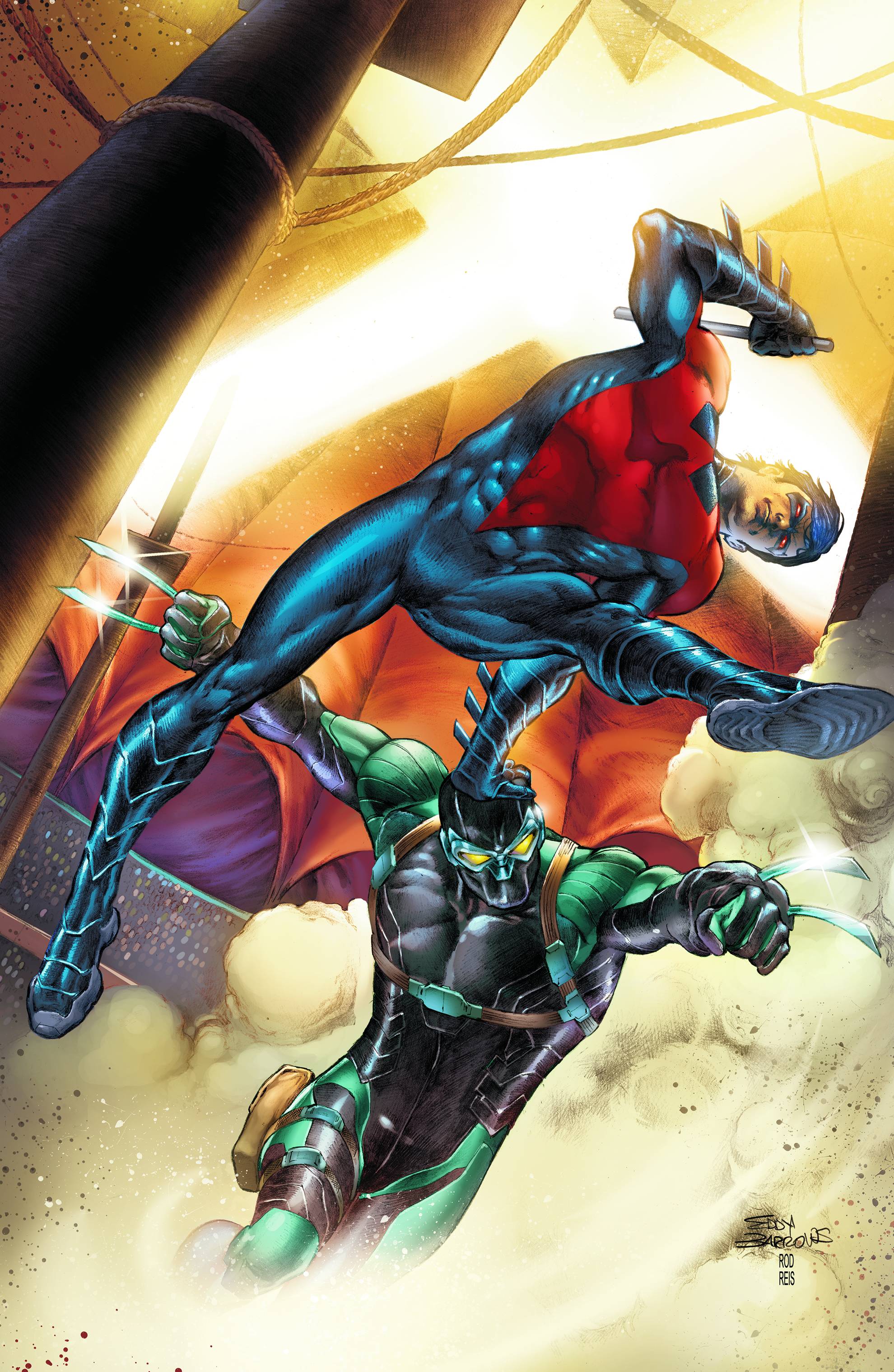
The notes for that 1996 first issue mention mention that Nightwing was "the most popular character in the DC Universe who's never had his own book," introducing the series after what it says was 12 years since the character's introduction into the universe. Original writer Chuck Dixon writes in that essay some things that I felt about the character, too, that Robin was never cool and nobody wanted to be Robin when they could choose Batman, but Nightwing was cool because at the end of the day, we liked Dick Grayson. I loved that he had Batman's skills but was less dark. I loved that his athletic abilities were born from a childhood spent in the circus. And I loved the outfit: a shock of bright blue around the collarbone, chest and arms of a tight black suit. I was probably in the general vicinity of Grayson age-wise when this comic came out, and it was a favorite.
So there was no question that I'd be following the relaunch of "Nightwing" with the New 52. I already knew that the blue in Nightwing's outfit had been changed from blue to red (I still think the blue looks a lot better and makes a lot more sense), and that Batman's sidekick story lines had grown a lot more complicated with what now stands as a lineage of four Robins, Grayson having been the first. And the cool logo for the title, with the center "T" stretching over the other letters like a new-aged bat symbol, has been replaced by something more lame and less creative. So, too, had I given up on following the Teen Titans, perhaps out of embarrassment that, as a grown man and father of two, if I was to continue to follow comic books, I should probably give up on the titles that feature "boy," "girl," or teen heroes. (You'll find out if you continue to follow my blog that I still gave a few of these titles a try.)
I read the new Batman first, and Dick Grayson plays a very dramatic role in the early issues of that relaunch as a sample of his DNA allows him to be targeted by Bruce as someone trying to kill him. By the end of the first handful of issues of that series, which if you've read a previous post, I've stated is one of the best (if not the best) of the New 52, we learn that Grayson was meant to be a high-ranking assassin in the Court of Owls and has a family connection to this terrifying organization.
Armed with that, I went into "Nightwing," which finds Grayson back in Gotham. The central emotional journey of the new title has Dick revisiting his past as Haly's circus - the one he grew up in - is in town. This is the very circus in which a young Dick watched his parents die before being adopted by Bruce. Dick reconnects with Raya, a circus performer from his past, and is soon up on the trapeze reliving old times until he's called into battle against an unknown masked foe who is every bit Nightwing's equal in acrobatic ability.
Dick loses track of his yet-unknown new foe and, in issue #2, is coaxed by Raya into a visit to the dying Mr. Haly, who hands over the deed to the circus to Dick. On the way home from the visit, Dick receives a phone call from the stranger, who identifies himself as Saiko. Saiko knows that Dick is Nightwing because he forced it out of Haly just before essentially killing him. At Haly's funeral, animosity grows over Dick's new role as owner of the circus because his presence has put a target on all of their backs. Dick is blamed by many for Haly's death. Raya tells Dick that Saiko was likely sent by Zane, a former circus associate who deflected after the circus fell apart. As Nightwing, Dick finds Zane in Chicago, where Zane gets in his head and forces Dick to relive the death of his parents and question his worth.
At the start of issue #4, Batgirl (Barbara Gordon) is in the streets fighting a shapeshifter and shows up at Dick's place, surprised to find him there with Raya, who seems very uncomfortable with the implied history between Dick and Barbara. Batgirl enlists Nightwing's help to take care of Spinebender (the shifter). Soon thereafter, while going through some of Haley's possessions, Dick uncovers a mysterious book that includes a bunch of names, the last one being his own. A surprise twist by the end of issue #5 further clarifies who Saiko is and who he's working with.
Raya invites Dick to participate in an anniversary tribute performance in memory of Dick's parents. Dick deduces that this will be where Saiko will attack, that he'll be looking for a public stage to do so. Still reluctant to be involved in the show at all, a visit from Alfred convinces him to go ahead with it. As expected, Saiko shows up, and mid-battle, Nightwing learns his true identity. The two have a history. Saiko sets a chemically-based fire off in the circus tent and reveals to Nightwing that he was "chosen by them" only after they couldn't get Dick, their first choice.
In a crossover with "Batman," with the key scene duplicated in "Nightwing," Dick goes to the Batcave, where Bruce is analyzing the body of The Talon and reveals to Dick that this high-ranking member of the Court of Owls is related to him. The man's name, William Cobb, was a name that appeared in the book Haley left to him. Issues #8-9 are part of the "Night of the Owls" story that carries over various Batman titles. Issue #8 ends with a cliffhanger, as Dick's chest and shoulders are filled with the same throwing knives that pierced Bruce at the hands of The Talon. The Talon/Cobb tells Dick that he was sent to murder him because he did not submit to the Court as he was destined to do. I don't want to spoil the details, but these later issues really deepen the history between Cobb and Grayson, as well as the story of the whole Grayson family and how the Court of Owls fits into it. If nothing else, "Nightwing" is required reading for those reading "Batman" just to understand these details more fully.
Issue #10 nicely sets up what should be a compelling new chapter in the Nightwing story, as Sonia Zucco, the daughter of the man who murdered Dick's parents, approaches Dick with an offer to revitalize Gotham's dilapidated amusement park as a new tourist destination to improve the city; she wants Haly's circus to remain at the site as its central attraction. The issue ends with Nightwing in jeopardy of being killed again, this time at the hands of a group of fighters led by someone who calls himself Paragon and tells Dick that he is "Gotham's true son" and that "the future of this city hinges on your death."
Writer Kyle Higgins is choosing to keep this rebooted "Nightwing" more closely tied to the Batman story, at least for now. What this does, to some extent, is it makes the reading of "Nightwing" fairly critical to "Batman" readers, no doubt a sales strategy with the reboot. Personally, I like that Dick Grayson is back in Gotham where his history lies, as opposed to having him fighting crime in his own version of Gotham City like had in the past. The glimpses of crossover work with Batman have an added layer of complexity because Nightwing is now, in a few ways, Batman's equal. The artwork in "Nightwing" is also consistent with the work in "Batman" (though "Batman" trumps it).
While Dick Grayson/Nightwing is no longer my absolute favorite character in the DCU (Green Lantern took over that honor for me right around the time that the 1996 "Nightwing" title was launched, ironically), he remains high on my list, and I can't see myself discontinuing my reading of "Nightwing" if I'm still going to read "Batman." I am impressed by the depth Higgins and his team are bringing to a character I thought I knew so well, and invigorated by his ability to use slow reveals and cliffhangers to keep me coming back for more.
"Nightwing" gets a "yes" for me as a title to keep reading in the New 52.
Subscribe to:
Posts (Atom)